TOOLS & GEAR
Meat Thermometer Reading the Wrong Temperature
THE SHORT ANSWER
Test it before you blame it. A slushy ice bath should read 32°F and a rolling boil should read 212°F at sea level, dropping about 1°F per 500 feet of elevation. If the reading is off by more than 2°F, either use the offset function if the model has one, or note the error and subtract it every time. A probe that reads differently on repeat dips, or that drifts while sitting still, has a damaged sensor and should be replaced.
pitandsear participates in the Amazon Services LLC Associates Program. If you buy through a link on this page we may earn a commission at no extra cost to you. Full disclosure.
Check these first (they cost nothing)
- Test it in a proper ice slurry — a glass packed with crushed ice and topped up with cold water, not a glass of water with cubes floating in it. It should read 32°F.
- Dip it twice in the same slurry. Two different readings means a damaged sensor rather than a calibration offset.
- Check where you have been putting the probe. A tip touching bone reads high and a tip in a fat pocket reads low, and neither is the thermometer’s fault.
- Look up your elevation. Water boils about 1°F lower for every 500 feet, so the boiling reference is not 212°F everywhere.
What's actually causing it
These are ordered deliberately. Number one is the cause that turns out to be the answer most often, so work down the list rather than jumping to the one that sounds most dramatic.
Probe placement rather than probe accuracy
Most commonHow to confirm it
The ice bath reads 32°F but the meat readings look wrong. Move the probe a half inch and watch the number change by ten degrees or more — that is placement, not calibration.
How to fix it
- Aim for the thermal center: the thickest part of the cut, furthest from any heat source.
- Keep the tip away from bone, which conducts heat and reads high.
- Keep it out of fat pockets and gaps, which read low.
- On thin cuts, enter through the edge at a shallow angle so the tip stays inside the meat.
- Take two or three readings in different spots and trust the lowest one.
Repair or replace — Fix it yourself. Nothing wrong with the instrument — this is the most common "faulty thermometer" that is not faulty.
The thermometer has drifted and needs an offset
CommonHow to confirm it
The ice bath reads consistently 3–8°F away from 32°F, and repeat dips give the same wrong number. Consistency is the key — a consistent error is correctable.
How to fix it
- Build a proper slurry: a tall glass packed with crushed ice, cold water added to the top of the ice, stirred and left two minutes.
- Insert the probe into the center without touching the sides or bottom, stir gently with the probe, and let the reading settle.
- If the model has a calibration button, set the offset here.
- On an analog dial, hold the hex nut under the face with pliers and turn the dial to 32°F.
- If there is no adjustment, write the error on tape stuck to the body and apply it every time.
Repair or replace — Fix it yourself with calibration. Replace only if the unit has no offset function and the error is large.
What you'll need
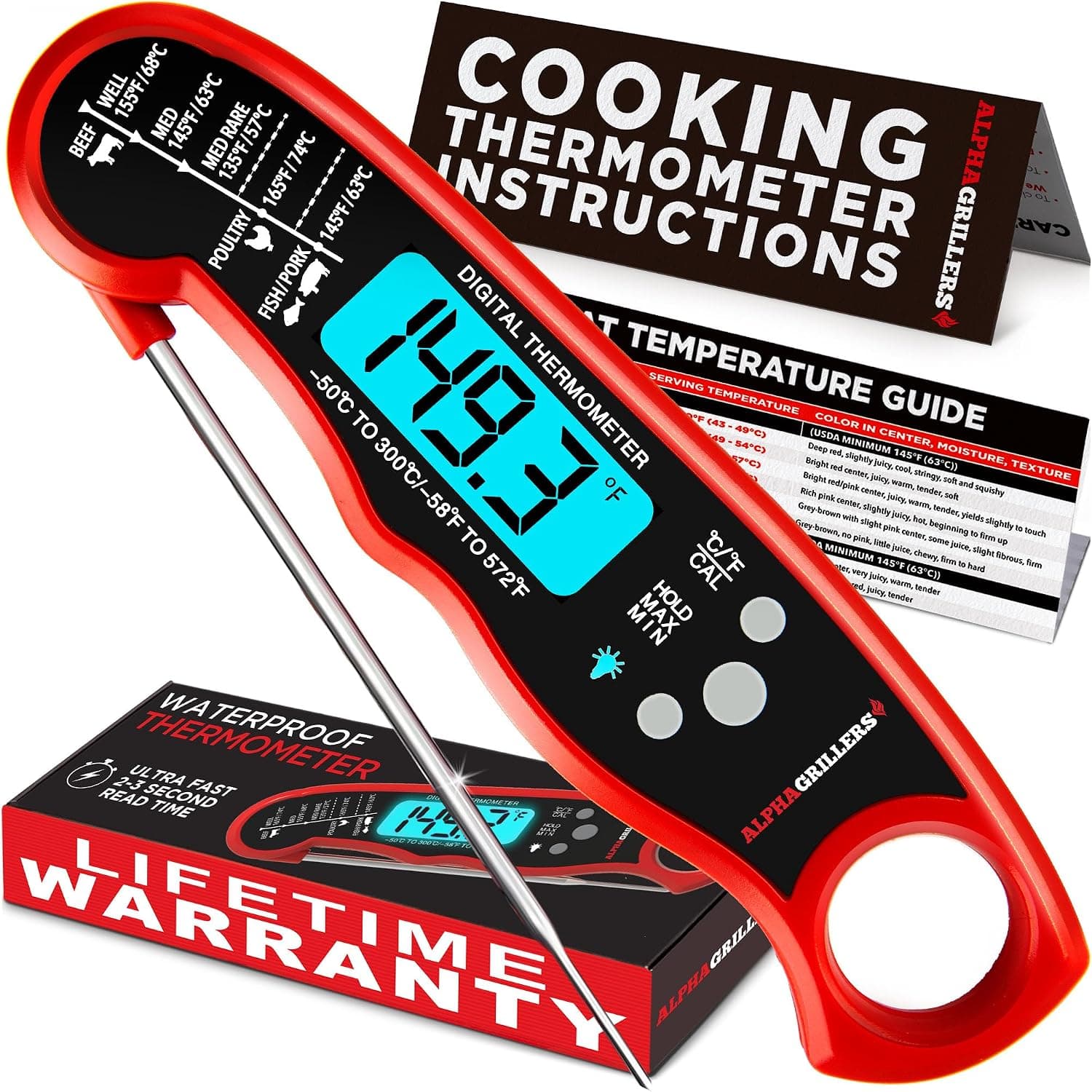 Best Overall
Alpha Grillers
Alpha Grillers Instant Read Meat Thermometer
Best for everyday spot checks at the grate
A straightforward instant-read that covers the job most people actually need: open the lid, get a number in a second or two, close the lid again. The IP67 rating means it survives being rinsed under a tap rather than only wiped, which is usually what decides how long a grill thermometer lasts. It ships pre-calibrated, so the ice-bath check becomes a verification rather than a setup step.
1–2 sec read, IP67, backlit
The sensor is damaged and reading non-linearly
CommonHow to confirm it
It passes one reference and fails the other — correct at 32°F but wrong at boiling, or vice versa. Or repeat dips into the same slurry give different numbers.
How to fix it
- Run both reference points: ice slurry at 32°F, and a rolling boil at 212°F corrected for your elevation.
- Repeat each three times to check consistency as well as accuracy.
- Understand that a non-linear error cannot be corrected with a single offset.
- Replace the unit. A drifting or erratic sensor is not repairable at home.
Repair or replace — Replace it. A thermometer that fails one reference and passes the other is worse than no thermometer at all.
What you'll need
How to choose meat thermometers & timers →Moisture has got into the handle or the probe joint
CommonHow to confirm it
The unit was washed, rained on, or run through a dishwasher, and the reading has been erratic since. Condensation may be visible behind the display.
How to fix it
- Stop using it until it has been thoroughly dried — several days in a warm dry place, or in a sealed container with silica gel.
- Remove the battery while it dries.
- Retest against both references before trusting it again.
- From here on, wash the probe stem only and never immerse the handle unless the model is explicitly rated for it.
Repair or replace — Replace it if drying does not restore consistent readings. Water in the electronics is generally terminal.
What you'll need
How to choose meat thermometers & timers →You are comparing it against the lid thermometer
Less commonHow to confirm it
The disagreement is between your probe and the dial in the grill lid, not between your probe and reality. The lid dial sits inches above the grate in a different air stream and is usually a cheap bimetallic unit.
How to fix it
- Trust the probe at grate level next to the food, not the lid dial.
- Clip a grate-level probe an inch or two from the meat, not touching it and not directly over the fire.
- Expect a 25–50°F difference between lid and grate as normal.
- If you want the lid dial to be useful, calibrate it too — most have an adjustment nut behind the face.
Repair or replace — Fix it yourself by changing which number you believe. Nothing is broken.
The battery is low
RareHow to confirm it
Readings have become slow, erratic or drift while the probe sits still, and the display may be dimmer than it was. Low voltage affects the analog-to-digital conversion before it kills the display.
How to fix it
- Replace the battery with a fresh cell of the correct type before doing anything else.
- Retest against the ice slurry once the new battery is in.
- Remove the battery entirely if the unit will sit unused for more than a couple of months.
- Clean any corrosion off the contacts with a cotton swab and isopropyl alcohol.
Repair or replace — Fix it yourself. Cheapest possible fix and worth ruling out before you condemn the unit.
All the causes side by side
| Cause | How to confirm | Fix time | Part needed | Difficulty |
|---|---|---|---|---|
| Probe placement rather than probe accuracy | The ice bath reads 32°F but the meat readings look wrong. Move the probe a half inch and watch the number change by ten degrees or more — that is placement, not calibration. | 2 minutes | None | Easy |
| The thermometer has drifted and needs an offset | The ice bath reads consistently 3–8°F away from 32°F, and repeat dips give the same wrong number. Consistency is the key — a consistent error is correctable. | 10 minutes | Meat Thermometers & Timers | Easy |
| The sensor is damaged and reading non-linearly | It passes one reference and fails the other — correct at 32°F but wrong at boiling, or vice versa. Or repeat dips into the same slurry give different numbers. | 15 minutes | Meat Thermometers & Timers | Easy |
| Moisture has got into the handle or the probe joint | The unit was washed, rained on, or run through a dishwasher, and the reading has been erratic since. Condensation may be visible behind the display. | 2–3 days of drying | Meat Thermometers & Timers | Moderate |
| You are comparing it against the lid thermometer | The disagreement is between your probe and the dial in the grill lid, not between your probe and reality. The lid dial sits inches above the grate in a different air stream and is usually a cheap bimetallic unit. | 5 minutes | None | Easy |
| The battery is low | Readings have become slow, erratic or drift while the probe sits still, and the display may be dimmer than it was. Low voltage affects the analog-to-digital conversion before it kills the display. | 5 minutes | None | Easy |
Stop it from coming back
A thermometer does not announce that it has drifted — it just quietly starts handing you the wrong number, and every cooking decision downstream inherits the error. The habit that prevents that is the ice bath: a glass packed with crushed ice, cold water to the top, two minutes to settle. It should read 32°F. Run it at the start of every season and any time the unit has been dropped, washed or left in a hot grill.
The other half is treating the probe as a precision instrument rather than a kitchen tool. Wash the stem, never the handle, unless the model is explicitly rated for immersion. Keep leave-in cables off the grate and out of the lid seam. Pull the battery if it is going into storage for a few months. Do those things and a good thermometer stays accurate for years; skip them and it fails in the way that is hardest to notice.
Related problems
TOOLS & GEAR
Wireless Probe Keeps Losing Connection
COOKING FAULTS
Chicken Burnt on the Outside, Raw in the Middle
HEAT & FIRE
Smoker Temperature Keeps Swinging Up and Down
SMOKE & TASTE
No Smoke Ring on the Brisket
Questions people actually ask
Fill a tall glass completely with crushed ice — packed, not loose — then add cold water only until it reaches the top of the ice, and stir. The glass should be mostly ice with water filling the gaps. A glass of water with a few cubes floating in it sits several degrees above freezing and will give a false pass.
Yes, significantly. Water boils at 212°F at sea level and roughly 1°F lower per 500 feet of elevation — about 208°F at 2,000 feet and 202°F at 5,000 feet. The freezing point is unaffected, which is why the ice bath is the more portable reference. Look your elevation up once and write it on the case.
More than 2°F is worth correcting. The practical window between safe and dry on chicken breast is about ten degrees, so a 5°F error consumes half your margin before you have made any decision. If the error is consistent you can offset it; if it varies, replace the unit.
Usually yes. Most have a hex nut directly under the dial face. Hold the nut with pliers while the probe is in the ice slurry and turn the dial face until it reads 32°F. Some sealed units have no adjustment, in which case note the offset and apply it mentally.
Because a steak genuinely is different temperatures in different places — that is not an error. The number that matters is the coldest point, which is the thermal center. Take two or three readings and act on the lowest, and keep the tip away from bone and fat.
Sources
pitandsear participates in the Amazon Services LLC Associates Program. If you buy through a link on this page we may earn a commission at no extra cost to you. Full disclosure.