HEAT & FIRE
Gas Grill Won't Get Hot Enough (2026 Diagnosis and Fix)
THE SHORT ANSWER
Nine times out of ten a gas grill that suddenly tops out around 250–300°F has tripped the excess-flow safety device inside the regulator, which happens when the lid is opened with the burner valves already on. Close all burner valves, shut the tank valve, disconnect the hose, wait sixty seconds, reconnect, open the tank valve slowly, then light. If the temperature still will not climb, the next suspects are a partly empty tank, clogged burner ports and a grill that is simply losing heat through a warped lid.
pitandsear participates in the Amazon Services LLC Associates Program. If you buy through a link on this page we may earn a commission at no extra cost to you. Full disclosure.
Check these first (they cost nothing)
- Confirm the burners are actually lighting. Look down through the grate with the lid open — you want steady blue flames with small yellow tips across the whole tube, not a few flames near the ignition end.
- Shake the tank. If it sloshes freely with almost no weight, you are near empty, and the last few pounds of propane vaporize slowly enough to cap your temperature.
- Check that you preheated long enough with the lid closed. Ten to fifteen minutes on high is the baseline; five minutes gets you nowhere near a searing temperature.
- Look at the lid thermometer versus reality. A cheap bimetallic dial reading 300°F when the grate is at 500°F is a very common false alarm.
What's actually causing it
These are ordered deliberately. Number one is the cause that turns out to be the answer most often, so work down the list rather than jumping to the one that sounds most dramatic.
The regulator safety device has tripped
Most commonHow to confirm it
Turn every burner to high with the lid open. If the flames are weak, low and roughly the same size on all burners no matter which knob you move, the regulator is limiting flow rather than a burner being blocked.
How to fix it
- Turn all burner control knobs to off.
- Close the valve on the propane tank and disconnect the hose coupling from the tank.
- Wait a full 60 seconds with everything disconnected — this is what lets the excess-flow device inside the regulator reseat.
- Reconnect the coupling hand-tight, then open the tank valve slowly, no more than a quarter turn at a time.
- Wait about 10 seconds before lighting the first burner, and light burners one at a time from the ignition end.
Repair or replace — Fix it yourself. Costs nothing and takes two minutes. The habit that prevents it is opening the tank valve slowly with the burner knobs already off.
The tank is lower than you think
CommonHow to confirm it
Weigh it. Every cylinder has its empty weight stamped on the collar as "TW" — subtract that from the total on a bathroom scale and what is left is propane. A standard tank holds about 20 lb.
How to fix it
- Weigh the tank and work out the remaining propane against the stamped tare weight.
- If you have less than about 4 lb left, expect reduced output on a cold day — liquid propane needs heat from the tank wall to vaporize, and a nearly empty tank has less surface area doing that work.
- Swap or refill rather than trying to finish the tank on a high-heat cook.
- On cold days, keep the spare tank outdoors but out of the wind; a wind-chilled cylinder delivers noticeably less.
Repair or replace — Fix it yourself. No parts, just fuel. Weighing the tank is far more reliable than the hot-water trick or a magnetic gauge.
Burner ports are blocked with grease and carbon
CommonHow to confirm it
With the grill cold and the tank off, pull the grates and flame tamers and look along each burner tube. Ports should be evenly spaced open holes. Dark crusted sections, or a burner that lights only near one end, confirm it.
How to fix it
- Close the tank valve, disconnect the hose and let the grill cool completely.
- Remove the grates and flame tamers, then lift out the burner tubes if your model allows it.
- Clear each blocked port by working a stiff wire or an opened paperclip across the hole, not down into the tube.
- Brush the outside of the tube along its length with a stainless brush, then tap the tube to shake debris out of the open end.
- Refit the burners and confirm each tube seats squarely over its gas orifice before reconnecting the tank.
Repair or replace — Fix it yourself with a wire and a brush. Replace the burner only if the tube is rusted through or the ports have corroded into one another.
What you'll need
 Best Overall
Scrub Daddy
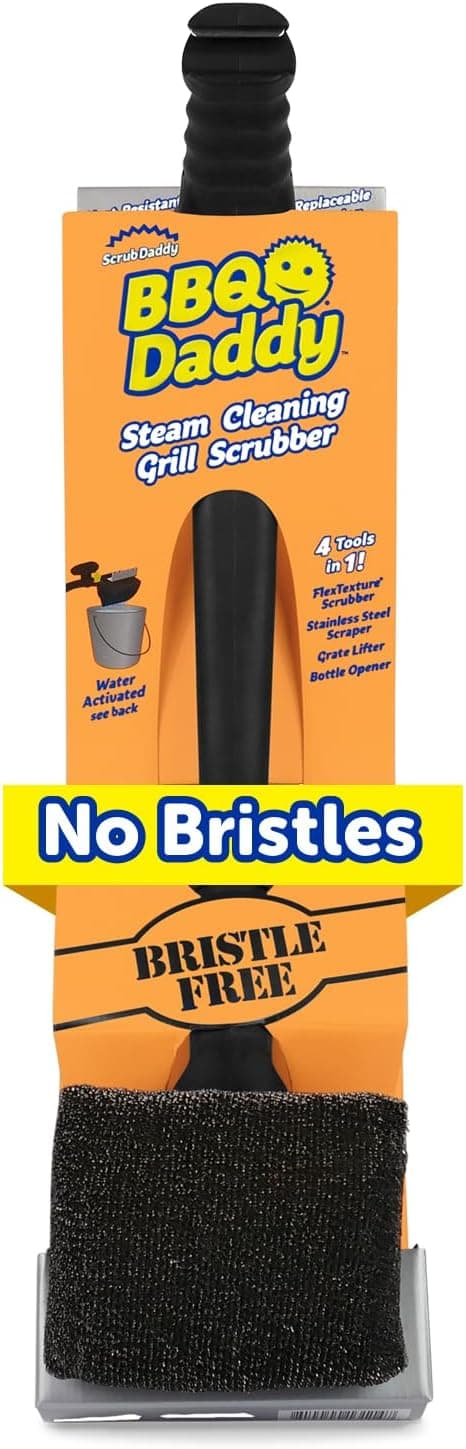
Scrub Daddy BBQ Daddy Grill Brush
Best for cleaning a hot grate with nothing loose to shed
Pairs a steel scraper for hardened carbon with a scrub head made from the temperature-reactive material the brand is known for, which firms up and softens with heat. Being bristle-free removes the failure mode this whole category exists to warn about — there are no loose wires to shed onto the grate. Two cleaning surfaces on one head means you actually use the right one.
Bristle-free, steel scraper + scrub head
Spiders or wasps have nested in the venturi
Less commonHow to confirm it
Look for lazy yellow flames instead of blue, a roaring or whistling noise at the control panel, or flame visible outside the burner tube near the valve. Shine a light into the venturi opening where the tube meets the orifice and check for webbing.
How to fix it
- Shut the gas off at the tank and disconnect it before touching anything.
- Remove the burner tube and inspect the venturi opening at the valve end.
- Clear webbing and nesting debris with a venturi brush or a flexible bottle brush pushed through the tube.
- Refit the tube over the orifice, checking alignment by eye from the front — a misaligned tube leaks gas into the cabinet.
- Fit the insect screens if your grill came with them; if it did not, cover the tube ends whenever the grill is stored.
Repair or replace — Fix it yourself. This is the classic cause after a grill has sat unused, and it is cleaning rather than repair.
Heat is escaping through a warped lid or failed gasket
Less commonHow to confirm it
Run the grill on high for ten minutes and look along the lid seam from the side. Visible smoke escaping in a steady stream from one section, or a lid that visibly does not sit flat, tells you the chamber is not holding heat.
How to fix it
- Check that nothing is propping the lid open — a warped flame tamer or an over-tall rotisserie bracket is a common culprit.
- On a kamado or a smoker with a gasket, run a dollar bill through the closed lid seam at several points; if it pulls out freely everywhere, the gasket is flat.
- Replace the gasket with a self-adhesive high-temperature strip rated for your cooker.
- If the lid itself is warped, accept the limit rather than chasing it — a warped lid on a gas grill usually means the grill is at the end of its life.
Repair or replace — Replace the gasket if there is one; otherwise this is the point where a replacement grill is more sensible than a repair.
The hose or regulator itself has failed
RareHow to confirm it
After the reset sequence has failed twice, run a soapy-water test on the full hose and both ends of the regulator. Growing bubbles anywhere, or a hose that feels brittle or has visible cracking, points here.
How to fix it
- Close the tank valve immediately if you see bubbles.
- Confirm the coupling nut is hand-tight — never wrench-tight — and retest.
- If it still bubbles, replace the whole hose-and-regulator assembly rather than trying to repair a section.
- Buy the assembly specified for your grill model; regulator output pressure is not universal across manufacturers.
Repair or replace — Replace the assembly. This is one of the few grill parts that is a safety component, so do not improvise a fix.
All the causes side by side
| Cause | How to confirm | Fix time | Part needed | Difficulty |
|---|---|---|---|---|
| The regulator safety device has tripped | Turn every burner to high with the lid open. If the flames are weak, low and roughly the same size on all burners no matter which knob you move, the regulator is limiting flow rather than a burner being blocked. | 2 minutes | None | Easy |
| The tank is lower than you think | Weigh it. Every cylinder has its empty weight stamped on the collar as "TW" — subtract that from the total on a bathroom scale and what is left is propane. A standard tank holds about 20 lb. | 10 minutes | None | Easy |
| Burner ports are blocked with grease and carbon | With the grill cold and the tank off, pull the grates and flame tamers and look along each burner tube. Ports should be evenly spaced open holes. Dark crusted sections, or a burner that lights only near one end, confirm it. | 45 minutes | Grill Brushes & Scrapers | Moderate |
| Spiders or wasps have nested in the venturi | Look for lazy yellow flames instead of blue, a roaring or whistling noise at the control panel, or flame visible outside the burner tube near the valve. Shine a light into the venturi opening where the tube meets the orifice and check for webbing. | 40 minutes | None | Moderate |
| Heat is escaping through a warped lid or failed gasket | Run the grill on high for ten minutes and look along the lid seam from the side. Visible smoke escaping in a steady stream from one section, or a lid that visibly does not sit flat, tells you the chamber is not holding heat. | 1 hour | None | Involved |
| The hose or regulator itself has failed | After the reset sequence has failed twice, run a soapy-water test on the full hose and both ends of the regulator. Growing bubbles anywhere, or a hose that feels brittle or has visible cracking, points here. | 30 minutes | None | Moderate |
Stop it from coming back
The single habit that prevents this is the order you open things. Burner knobs off first, then open the tank valve slowly — a quarter turn, pause, then the rest. Opening a tank valve fast with a burner knob already on is what convinces the regulator that a hose has ruptured, and it responds by throttling you down to a trickle.
Everything else is a twice-a-season job: look along the burner tubes for blocked ports, run a soapy-water check on the hose whenever you swap a tank, and cover the burner ends when the grill goes into storage so spiders cannot nest in the venturis over winter.
Related problems
HEAT & FIRE
One Side of the Grill Runs Much Hotter Than the Other
HEAT & FIRE
Smoker Temperature Keeps Swinging Up and Down
TOOLS & GEAR
Meat Thermometer Reading the Wrong Temperature
COOKING FAULTS
Constant Flare-Ups Are Charring Everything
Questions people actually ask
A working full-size gas grill preheated for 10–15 minutes on high with the lid closed should reach roughly 500–550°F at the grate, and many go higher. If yours sits at 250–300°F no matter how long you wait, that is the classic signature of a tripped regulator rather than a worn-out grill.
That is normal and it is not a fault. An open lid dumps the hot air the grill has been holding, and recovery takes several minutes. What matters is how fast it comes back. If it recovers in two or three minutes you are fine; if it never climbs back, work through the causes above.
Yes. Liquid propane draws heat from the tank wall in order to vaporize, so a cold tank delivers less. Combine near-freezing air with a nearly empty cylinder and the pressure drop is enough to cap a grill several hundred degrees below its normal ceiling. A fuller tank helps more than anything else you can do.
Do not. The wait is the reset. The excess-flow device needs the pressure on both sides of it to equalize before it will reseat, and rushing the sequence is the most common reason people conclude the reset did not work and go buy a regulator they did not need.
It can be. If low heat comes with a gas smell, yellow lazy flames, flames outside the burner tube, or a roaring noise near the control panel, stop and shut the tank off. Those point to a leak or a blocked venturi rather than a fuel-supply issue, and both need resolving before the grill is used again.
Sources
pitandsear participates in the Amazon Services LLC Associates Program. If you buy through a link on this page we may earn a commission at no extra cost to you. Full disclosure.