SMOKE & TASTE
Everything Tastes Like Lighter Fluid
THE SHORT ANSWER
The chemical taste is unburned hydrocarbon, and it happens when food goes on before the fluid has fully burnt off or when fluid is added to coals that are already lit. Wait until every briquette is ashed over gray — usually 15–20 minutes after lighting — before cooking. Better still, switch to a chimney starter with a sheet of newspaper or a paraffin cube, which removes the problem permanently and costs less over a season.
pitandsear participates in the Amazon Services LLC Associates Program. If you buy through a link on this page we may earn a commission at no extra cost to you. Full disclosure.
Check these first (they cost nothing)
- Time your wait. Every briquette should be ashed over gray before food goes on, which takes 15–20 minutes after lighting, not five.
- Check whether fluid was added after lighting. Squirting more onto burning coals is the single fastest way to get petroleum into food — and it can flash back to the bottle.
- Smell the coals rather than the food. If the fuel bed still smells of solvent, it has not finished burning off.
- Check what the charcoal itself is. Instant-light briquettes are pre-soaked, so the same wait applies even when you did not add anything.
What's actually causing it
These are ordered deliberately. Number one is the cause that turns out to be the answer most often, so work down the list rather than jumping to the one that sounds most dramatic.
Food went on before the fluid had fully burned off
Most commonHow to confirm it
You lit the coals and started cooking within about ten minutes. Some briquettes still show black patches rather than an even gray ash coat.
How to fix it
- Light the coals and then leave them completely alone for 15–20 minutes.
- Wait until every briquette is coated in gray ash — no black patches anywhere in the bed.
- Rake the bed into position and give it another two or three minutes to settle.
- Only then put food on. The wait is the fix.
Repair or replace — Fix it yourself by waiting longer. Nothing to buy and it resolves most cases outright.
More fluid added to coals that were already lit
CommonHow to confirm it
The fire was slow, so you gave it another squirt. That fluid does not have time to burn off before it vaporizes onto the food, and the taste is unmistakable.
How to fix it
- Never add lighter fluid to coals that are burning, even faintly — the vapor can flash back up the stream to the bottle.
- If the fire is struggling, add more fuel and improve airflow rather than more accelerant.
- Store the fluid well away from the grill so reaching for it is not the reflex.
- If fluid has just been added, wait a further 15 minutes before cooking.
Repair or replace — Fix it yourself, and treat this one as a safety rule rather than a technique tip.
Too much fluid used in the first place
CommonHow to confirm it
The coals were soaked rather than dampened, and there was a large flame for a long time after lighting. Excess fluid pools at the bottom of the bed where it burns off slowly and incompletely.
How to fix it
- If you use fluid at all, apply a light coating and let it soak in for a minute before lighting.
- Build the coals into a pyramid so the fire spreads upward through the bed rather than sitting in a puddle.
- Switch to a chimney starter with a sheet of newspaper or a paraffin cube underneath — it removes the problem entirely.
- A chimney costs less than a season of lighter fluid and lights a full load in 15–20 minutes.
Repair or replace — Fix it yourself. A chimney starter is the durable answer, but using less fluid works today.
Instant-light or match-light briquettes
CommonHow to confirm it
You did not add anything, but the bag says instant-light or match-light. Those briquettes are impregnated with accelerant, so the same burn-off wait applies.
How to fix it
- Give instant-light briquettes the full 15–20 minutes to ash over, exactly as you would fluid-soaked coals.
- Do not add instant-light briquettes mid-cook to top up a fire — the accelerant goes straight onto the food.
- For refuelling during a cook, keep a bag of plain briquettes or lump charcoal alongside.
- Consider switching to lump charcoal or plain briquettes with a chimney for everything.
Repair or replace — Fix it yourself by reading the bag. Instant-light is convenient for the first load and wrong for every load after it.
Residue from a previous cook still in the grill
Less commonHow to confirm it
The taste persists into cooks where no fluid was used at all. Fluid residue soaks into old ash and into greasy deposits and re-volatilizes on the next fire.
How to fix it
- Empty the ash catcher completely and wipe out the firebox.
- Scrape the grates and the underside of the lid, where vaporized residue condenses.
- Run the empty grill hot for 20 minutes with the lid closed to burn off what is left.
- Start the next cook with fresh fuel in a clean bed.
Repair or replace — Fix it yourself with a clean-out. One thorough session clears it and it does not come back.
What you'll need
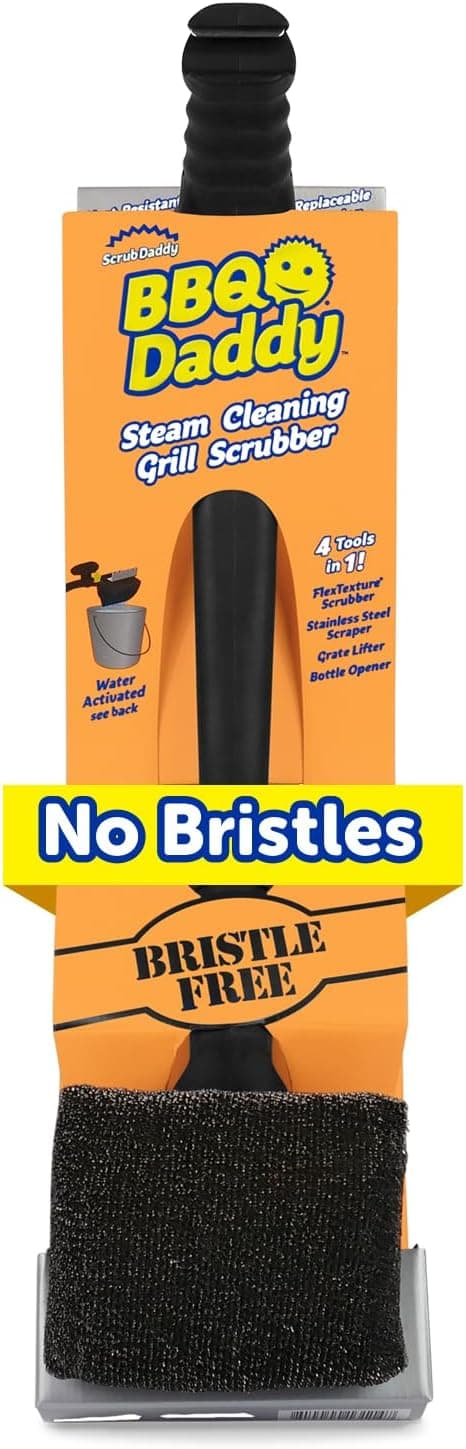 Best Overall
Scrub Daddy
Scrub Daddy BBQ Daddy Grill Brush
Best for cleaning a hot grate with nothing loose to shed
Pairs a steel scraper for hardened carbon with a scrub head made from the temperature-reactive material the brand is known for, which firms up and softens with heat. Being bristle-free removes the failure mode this whole category exists to warn about — there are no loose wires to shed onto the grate. Two cleaning surfaces on one head means you actually use the right one.
Bristle-free, steel scraper + scrub head
All the causes side by side
| Cause | How to confirm | Fix time | Part needed | Difficulty |
|---|---|---|---|---|
| Food went on before the fluid had fully burned off | You lit the coals and started cooking within about ten minutes. Some briquettes still show black patches rather than an even gray ash coat. | 20 minutes | None | Easy |
| More fluid added to coals that were already lit | The fire was slow, so you gave it another squirt. That fluid does not have time to burn off before it vaporizes onto the food, and the taste is unmistakable. | 15 minutes | None | Easy |
| Too much fluid used in the first place | The coals were soaked rather than dampened, and there was a large flame for a long time after lighting. Excess fluid pools at the bottom of the bed where it burns off slowly and incompletely. | 5 minutes | None | Easy |
| Instant-light or match-light briquettes | You did not add anything, but the bag says instant-light or match-light. Those briquettes are impregnated with accelerant, so the same burn-off wait applies. | 20 minutes | None | Easy |
| Residue from a previous cook still in the grill | The taste persists into cooks where no fluid was used at all. Fluid residue soaks into old ash and into greasy deposits and re-volatilizes on the next fire. | 40 minutes | Grill Brushes & Scrapers | Moderate |
Stop it from coming back
This is the rare problem that you can eliminate permanently in one decision. A chimney starter lights a full load of charcoal with a sheet of newspaper or a paraffin cube in 15–20 minutes, produces no petroleum vapor at all, and costs less over a season than the fluid it replaces. Once you own one, the taste is simply never available to happen again.
If you keep using fluid, the discipline is short: a light coating rather than a soaking, lit once and never topped up, then a full 15–20 minute wait until every briquette is gray. The same wait applies to instant-light briquettes even though you did not add anything, and never add instant-light fuel to a fire that is already running — that accelerant goes straight onto whatever is cooking.
Related problems
SMOKE & TASTE
Food Tastes Bitter and Over-Smoked
SMOKE & TASTE
No Smoke Ring on the Brisket
OPEN FIRE
Campfire Is Too Hot to Roast Anything Properly
RESIDUE & DEBRIS
Black Flakes Coming Off the Grates Onto Food
Questions people actually ask
Fifteen to twenty minutes from lighting, and the visual test matters more than the clock: every briquette should be coated in gray ash with no black patches showing. Lump charcoal is usually ready a little sooner than briquettes, but the ash test is the same.
The quantities involved after a proper burn-off are very small, and the practical problem is flavor rather than toxicity. The genuine hazard with lighter fluid is not the residue — it is adding it to a lit fire, where vapor can flash back to the container.
No, never. Gasoline vapor ignites explosively and kerosene leaves heavy unburned residue. Neither is formulated for the job and both cause serious injuries every year. Use a chimney starter, or charcoal lighter fluid used correctly.
You largely cannot — the flavor is absorbed into the surface. Trimming the outer layer helps, and a strongly flavored sauce masks some of it. The realistic move is to treat the batch as a loss, clean the grill out, and change the lighting method.
Yes. The chimney creates a strong convection draft that pulls flame up through the fuel, which is why a single sheet of newspaper or one paraffin cube underneath is enough to light a full load. It is faster than fluid as well as cleaner.
Sources
pitandsear participates in the Amazon Services LLC Associates Program. If you buy through a link on this page we may earn a commission at no extra cost to you. Full disclosure.